
Multihulls are far from a modern invention. The expert, courageous seafarers of Austronesia, an area encompassing the western and southern Pacific Ocean, south east Asia and Indonesia, developed a trimaran some 4000 years ago by adding two outboard floats to single-hull dug out canoes to offer greater stability in ocean swells, thereby extending their fishing grounds and allowing exploration over greater distances. The ‘proa’, traditionally an asymmetric double-hulled craft, has a similarly long history and is still in use today in some of the South Asian islands. Meanwhile, in the Atlantic and Europe monohulls dominated until explorers encountered the Austronesian multihulls in the 15th and 16th centuries and exported the concept back to Europe. Yet it’s comparatively recently that multihulls have become a regular sight. Through improvements in design, the rigidity of modern materials and more refined manufacturing processes, multihulls are today gaining in prominence and account for an increasing share of the yacht market. Catamarans are still far more numerous than trimarans, although the three-hulled concept is becoming better known as trimarans dominate the offshore racing scene. Cruising trimarans are still a relatively rare sight but interest is picking up and we certainly get many questions and comments from other sailors or passers-by when we are in marinas.
To find out more about Skylark, how we ended up choosing a trimaran, and why she’s called Skylark, scroll down and read on!
If you’re interested in the systems Skylark has, what equipment we use and what we think of it, or a bit more about Skylark’s performance (including what we find frustrating!), click below for our Technical section.
Skylark of Dartmouth
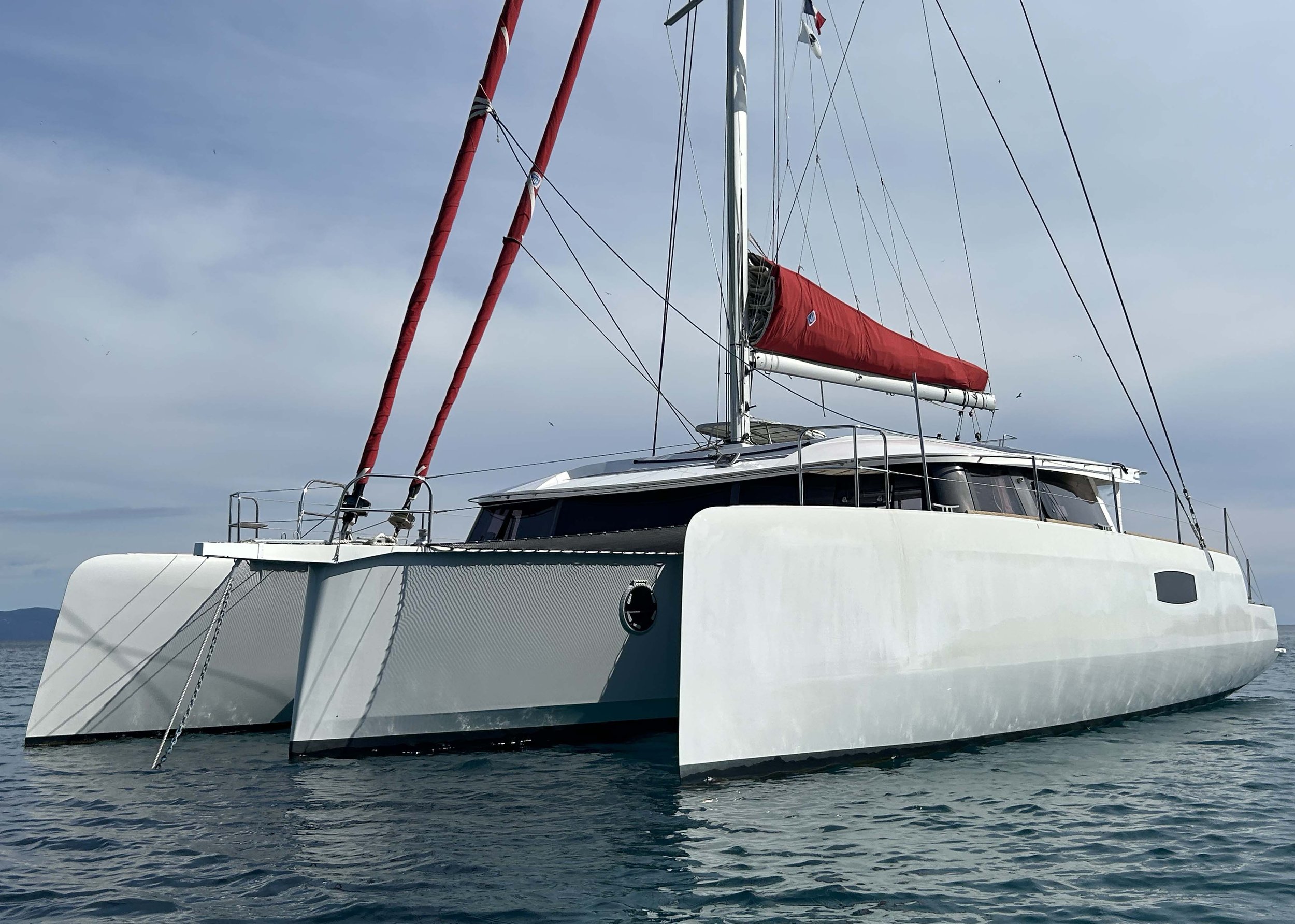
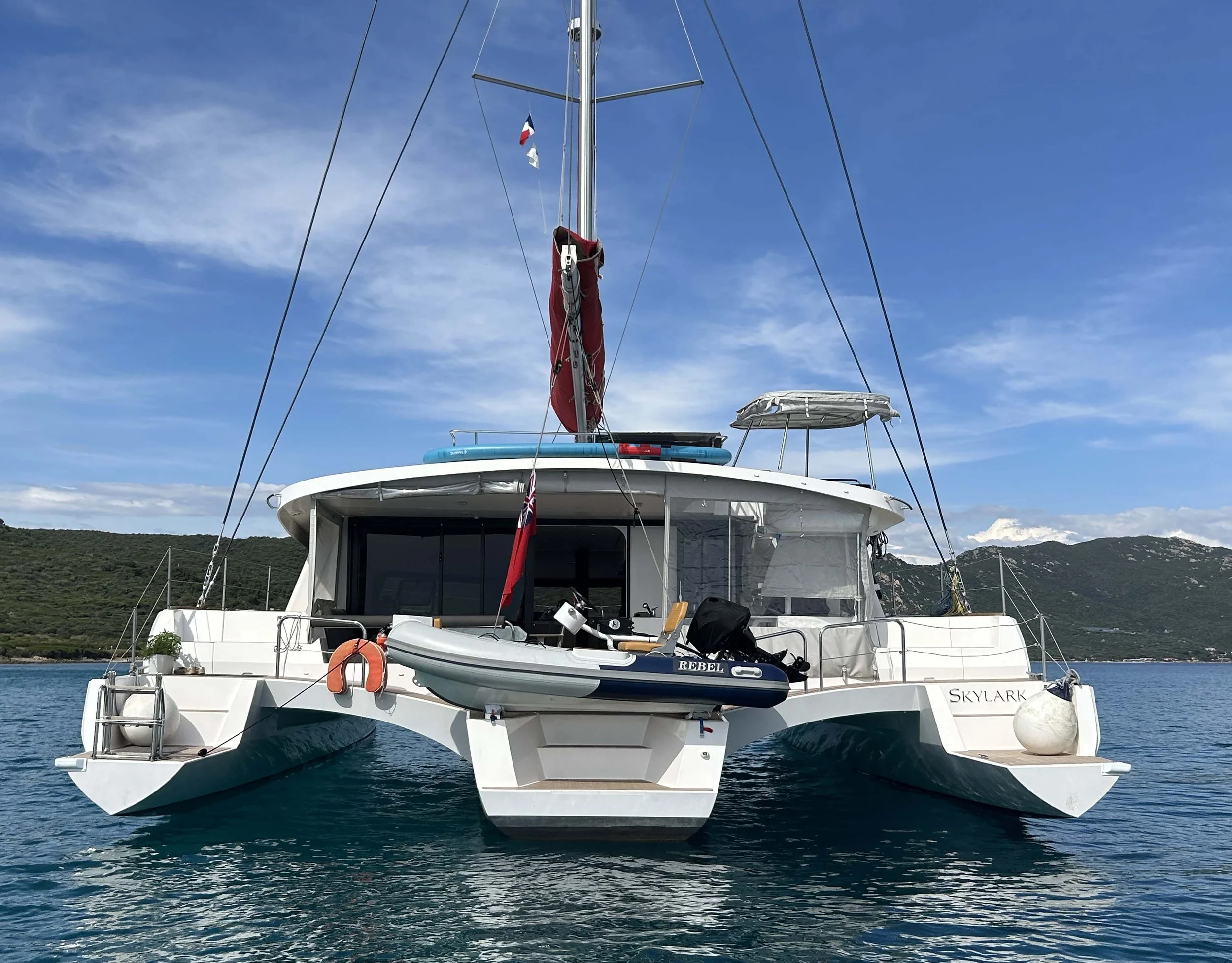
Built by Neel Trimarans in La Rochelle and launched in 2022, Skylark is hull number 34 of the run of 40 Neel 51s. We bought her in south west France in February 2025 having travelled on both sides of the Atlantic to look at several yachts. She was little used; some of the mattresses had their original plastic coverings on! She was, to all intents and purposes, an ‘as new’ yacht in pristine condition. We spent a few months gradually moving onboard and making her our floating home before setting out on our first voyage in April 25. We also reflagged her onto the UK Small Ships Register Part 1, renaming her Skylark and choosing Dartmouth as her home port.
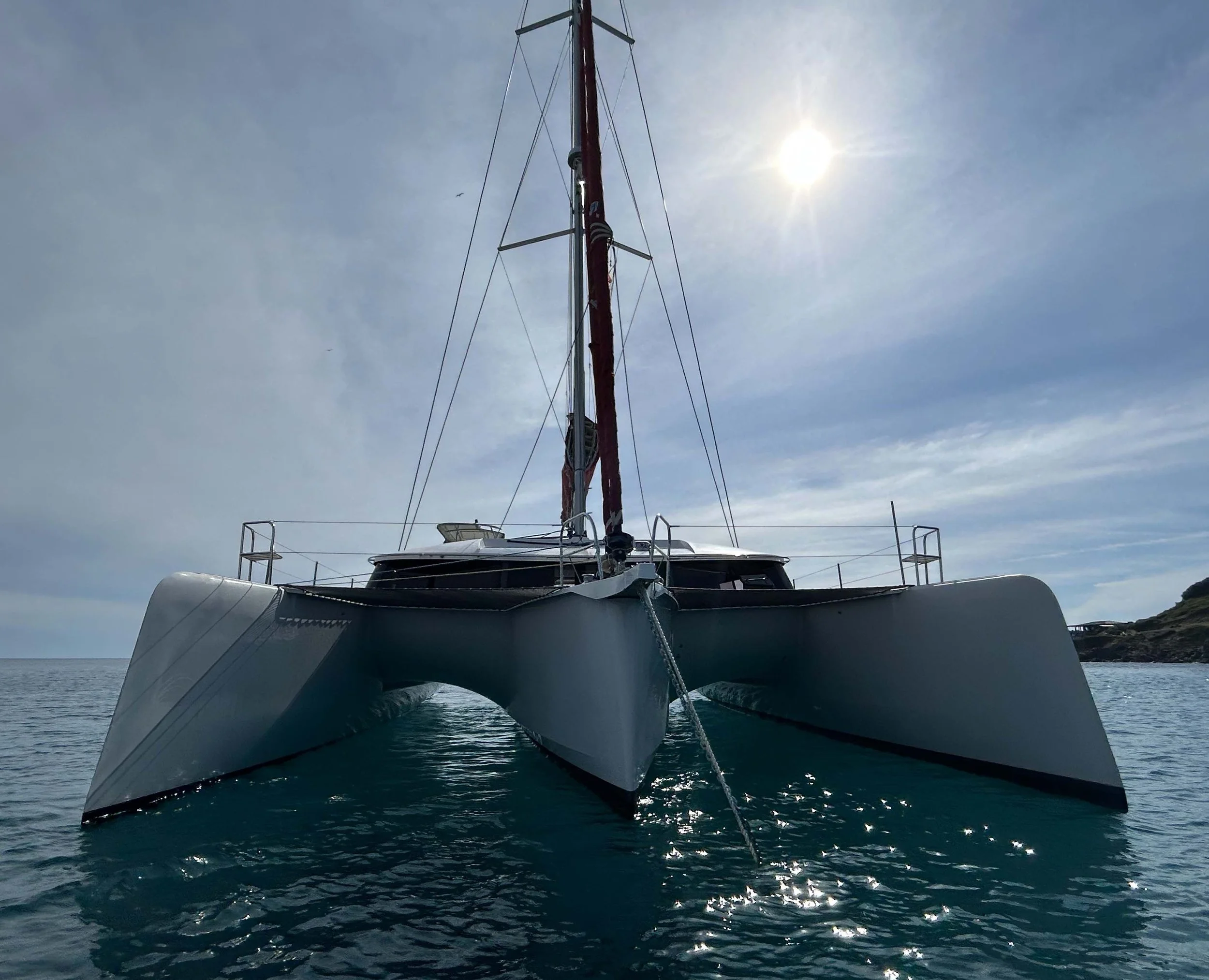
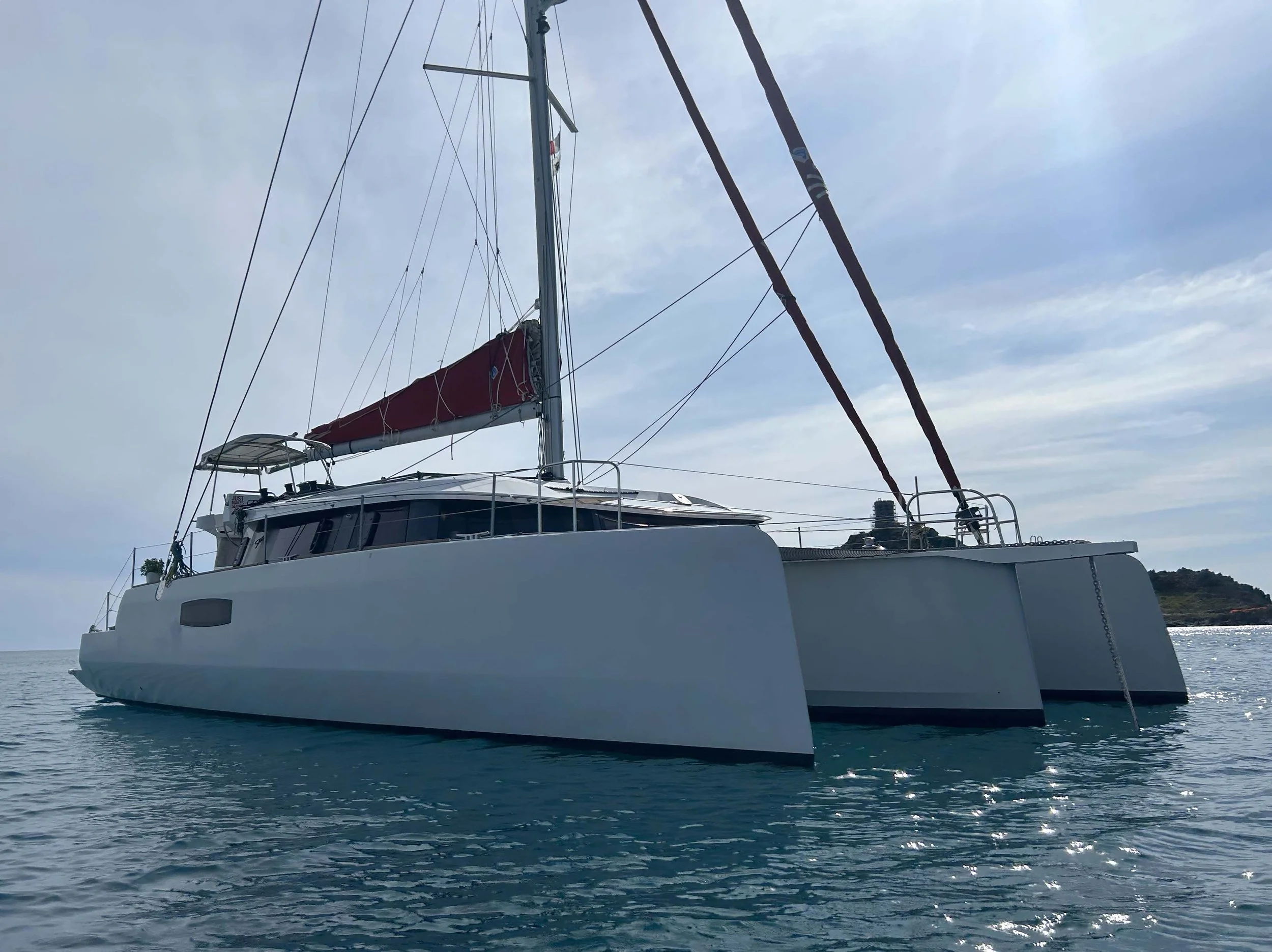
At 51 feet long (just under 16 metres) Skylark is not a small boat, but what really surprises people when they first step aboard is her overall size. She is 29 feet in the beam (nearly 9 meters), her main deck spread across all three hulls. This gives an enormous open-plan living space, galley and internal navigation station, with huge sliding doors which open onto a large outside cockpit area. The master cabin, with its own shower and separate head, is also on this deck. Each outer hull (known as an ‘ama’) has its own double cabin, vanity area and head/shower ensuite, so guests get space and privacy. A fourth double cabin is found in the front of the central hull, the ‘vee’ berth, again with its own shower and head. Also in the main hull is the central technical space, a huge area for storage and all Skylark’s systems; engine, generator, water-maker, air conditioning, batteries, battery management, fuses, fuel tank and water tank. There is a slightly more austere skipper’s cabin in the aft end of the starboard ama, and even a crew bunk in the front of the same ama.
Skylark has a three-sail ‘Solent’ rig, with a mainsail, furling genoa and furling jib permanently set up. We also have a huge asymmetric spinnaker for reaching and downwind sailing. Two of the three winches are electric, and she is easily handled with just the two of us. Anchoring is straightforward, but manoeuvring in tight bays or marinas can be tricky, especially in crosswinds. It’s all a learning process, and sailing is most certainly a spectator sport!
Why a trimaran?
We had always assumed we would fulfil our sailing adventures onboard a traditional monohull, albeit one set up for comfortable blue-water cruising. Over the years we have sailed Beneteaus, Janneaus, Dufours, Elans, Bavarias, Contessas, Oysters - the list is long. We enjoyed the sailing performance, but were often left feeling less convinced about the living spaces, especially having to disappear into a lower saloon to prepare meals, compromising the views of the spectacular surroundings we were in while feeling detached from those on deck. We looked at ‘deck saloon’ yachts - the likes of Discovery and Southerly. A raised seating area and chart table were definite plusses, but the rest of the accommodation, including the galley, was still tucked away. So how about a catamaran? I (Nick) had sailed in catamarans as a youngster (my grandfather owned a Catalac 9m) and while it had the space the motion was, well, different and not one I enjoyed and the sailing performance was, in truth, mediocre. But curiosity is healthy, so we hired a modern catamaran in Croatia a few years ago to retest our views. Today’s catamaran designs are really pushing boundaries. They can sail incredibly well, but the motion in a quartering sea is still one we both just don't get on with.
So back to the monohull idea, and Discovery were coming out on top. We visited their (sadly now closed) yard, and thought we could make a well-sorted, second-hand Discovery 55 work for us. So we kept an eye on the market, but before we could arrange any test sails Nick stumbled across Neel cruising trimarans in a magazine article which was reviewing the Neel 51. The author wrote of a living space larger than a catamaran combined with a sailing ability and feel more akin to a monohull. Really? Too good to be true, surely? We were aware of other well-established trimaran manufacturers such as Rapido, Dragonfly, and the smaller Farrier, Corsair and Astus, but the yachts are essentially a single central hull with floats (amas) that offer huge stability and storage but no accommodation. Adrenaline-fuelled sailing, for sure, but our adventures were about living as much as, if not more than, sailing. Neel were trying something different, with double cabins in each of the amas and a single level for living that spanned the three hulls, giving access throughout the boat. Interest was piqued, but we had never stepped onboard a tri so it seemed eminently sensible to try one out. We visited the Neel factory in La Rochelle and had an in depth tour of the manufacturing process. So far so good, but we still wanted to actually sail one. We found a company chartering a Neel 51 in Corsica, and, joined by Nick’s parents and cousin, did the ‘try before you buy’. We walked away convinced it could work for us. Stacks of space, a living deck entirely above the waterline, tremendous views from the wrap-around windows, and, yes, a sailing ability that was exciting and, in the right conditions, fast yet immensely stable. The search was on! After nearly two years, several viewings in both Europe and the USA, and much debate, we found what is now Skylark in late 2024, raided the savings, and bought her as an almost-new Neel 51 a few months later.
Skylark is now our second home, and we are exceptionally happy with her. She is safe, stable, and spacious, with extensive equipment designed to make life comfortable and enjoyable. Although she is definitely a cruising yacht rather than a racing boat, her performance is enjoyable on all points of sail. She’s happiest sailing a little ‘free’; she won’t point quite as high as a modern monohull and performance falls off noticeably if she’s pressed too close to the wind. But bear away 5 degrees and she picks up speed handsomely. She’s very responsive, although with the large square-topped mainsail tacking can be tricky in light winds - anything below about 5 knots. Give her 15 knots-plus she flies, heeling just enough to offer decent helm feel with the windward hull barely skimming the water. Skylark is a strong, safe boat that will take far more rough and tumble than us. She’s a proper ocean-going yacht and is a beautiful home for us to live out our sailing adventures.
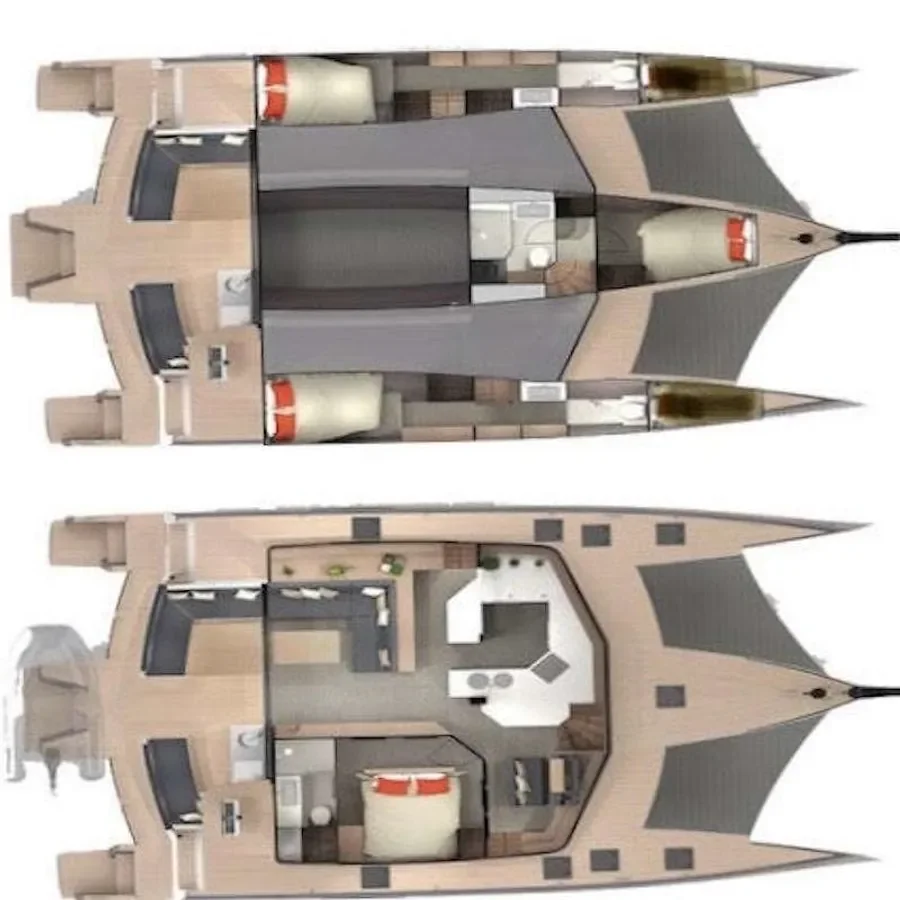
Image courtesy of Country Life
What’s in a name?
Why Skylark? And why Dartmouth? Well, the profile of the boat, especially from the front, resembles a bird in flight and she will happily ‘fly’ a hull in a decent breeze. Nick has a link to the sky and flying and a worrying history of ‘larking about’ in boats; it’s definitely his happy place! For Abbey, skylarks and their beautiful song are associated with poignant memories of Devon and in particular walks with her late mother. Dartmouth has a strong maritime heritage and plays host to the famous Britannia Royal Naval College that Nick attended. Abbey and Nick have spent many happy days in Dartmouth over the last 35 years and, to us, the name symbolises home and happiness.
What is the skylark a symbol of? Countless poems songs, artworks, works of literature and folklore stories have been written about this beloved farmland bird. Considered by many as a symbol of joy and freedom in many European cultures, while the Native Americans considered the bird symbolic of taking risks with bravery and courage.
‘To a Skylark’ Is a famous poem by Percy Bysshe Shelley (1820) - inspired by an evening walk in the countryside near Livorno, Italy with his wife Mary Shelly. The opening lines:
Hail to thee, blithe Spirit! Bird thou never wert, That Heaven, or near it, Pourest thy full heart in profuse strains of unpremeditated art.
The Blue Ensign
The UK allows three colours of Ensign; White, Blue and Red.
The White Ensign is reserved for ships of the Royal Navy, yachts belonging to the Royal Yacht Squadron, and ships of Trinity House, the national lighthouse and navigational aids organisation, when escorting the monarch.
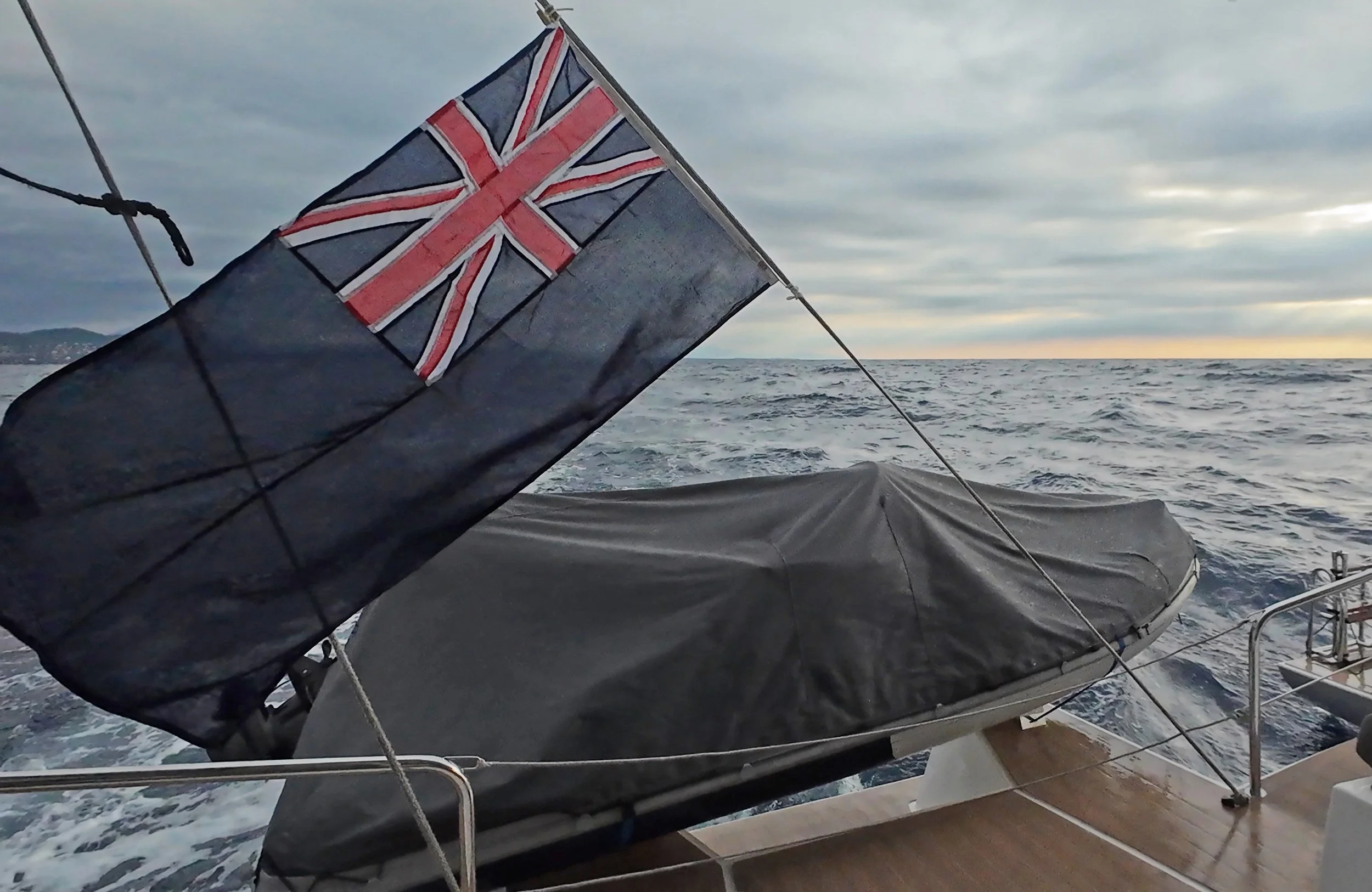
The Blue Ensign is authorised for use on merchant vessels whose master holds a commission in the Royal Naval Reserve. All Royal Fleet Auxiliary vessels fly the Blue ensign. It is also used by Royal Research ships and yachts of certain yacht clubs are also authorised to fly it. Most yacht club blue ensigns are ‘defaced’, that is they have the relevant yacht club badge or crest in the lower corner opposite the union flag, but a few are ‘undefaced’, as that on Skylark is. Nick is entitled to fly an undefaced Blue Ensign by virtue of being a member of the Royal Naval Sailing Association.
The Red Ensign is the general civil ensign, worn by all other classes of vessels including most private and pleasure vessels on the UK Small Ships Register. It is often referred to as the ‘Red Duster’ and can also be undefaced or defaced with yacht club crests and other badges.